
Finance Available
Swan Finance provides a flexible, private banking-style approach to customer services, offering a professional and innovative financial vision that looks beyond standard funding packages.
Aston Martin Halford Special
Chassis 1916
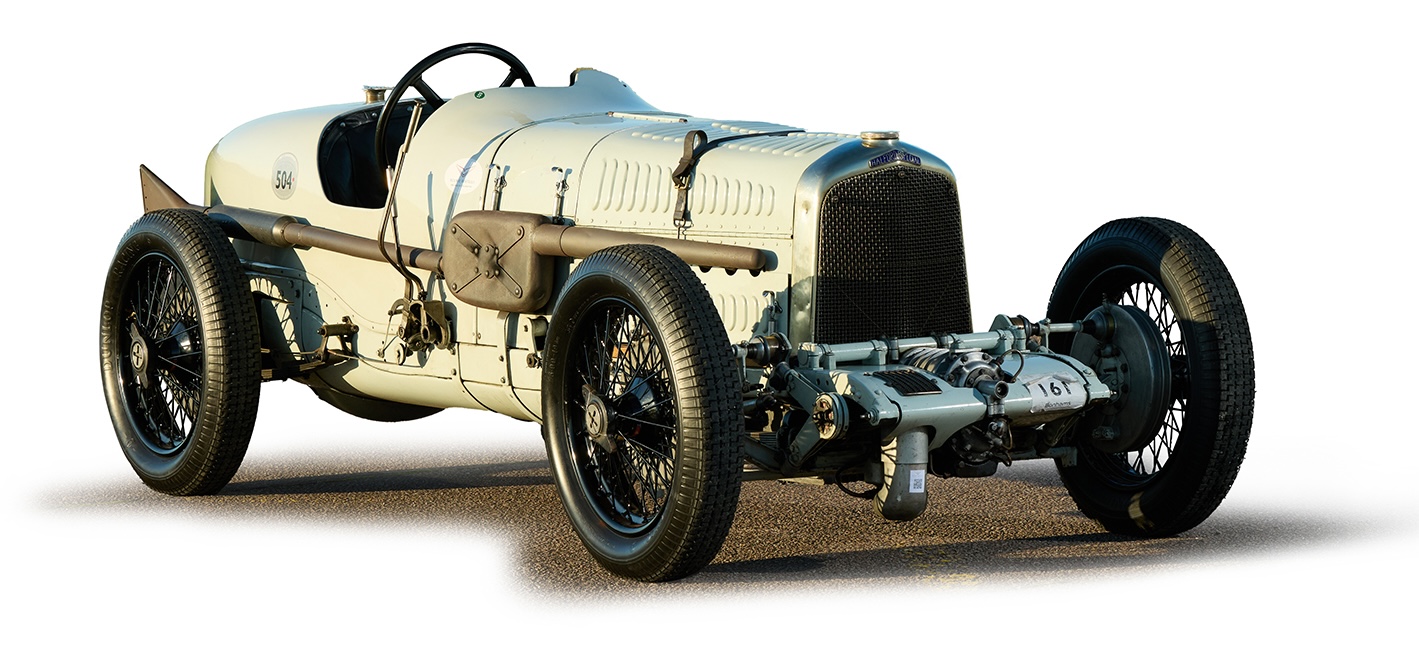
Few pre-war cars carry a story as rich as the Halford Special. Conceived and built by Major Frank Halford — one of the most gifted engineers Britain has ever produced — on the chassis of the very first Aston Martins built for sale, it was among the most advanced British racing cars of its era. It lined up for the first British Grand Prix in 1926 with an engine of its maker’s own design, passed through the hands of a future tripple World Land Speed Record holder, and survives today in original specification — still quick enough to be welcome at the world’s finest historic events.
One of the First Aston Martins
The car began life as Bamford & Martin chassis number 1916, — the first Aston Martin built for sale. In its original form it competed at Brooklands and during 1923, appearing at the Aston Hill climb and taking fourth place at the Junior Car Club’s Spring Meeting, one of just a handful of Aston Martins to compete here. The following year it was entered for the Voiturette race at Boulogne, driven by the young George Eyston, where it was crashed — an accident that would, as it turned out, give the car its defining chapter.
Major Frank Halford — Engineer Extraordinaire
The man who bought that damaged chassis was no ordinary privateer. Major Frank Bernard Halford (1894–1955) ranks among the most accomplished engine designers in British history — a figure whose work spanned the pioneering days of aviation through to the jet age.
Halford learned to fly at Brooklands in 1913 and, by the age of nineteen, was the youngest flying instructor in the country. During the First World War he served with the Royal Flying Corps and, recalled to engineering duties, developed the Beardmore-Halford-Pullinger (BHP) engine — the basis of the Siddeley Puma that powered the DH.4 and DH.9. It was in these years that he began a lifelong association with Geoffrey de Havilland.
Through the 1920s and beyond, Halford designed a succession of engines that shaped British aviation: the de Havilland Gipsy series, which powered the aircraft of pioneering long-distance flights including Amy Johnson’s 1930 solo flight from England to Australia; the mighty Napier Sabre, a twenty-four-cylinder engine of some 3,500 horsepower that powered the Hawker Typhoon and Tempest and stands among the most powerful piston aero engines ever built; and, at the dawn of the jet age, the de Havilland Goblin and Ghost. The Ghost powered the de Havilland Comet — the world’s first jet airliner. A Fellow and later President of the Royal Aeronautical Society, and appointed CBE in 1948, Halford designed engines that flew from the era of the biplane to the threshold of modern jet travel.
His connection to Aston Martin ran deep. He had helped keep the fledgling Bamford & Martin company afloat with personal loans, and raced its works cars — including the celebrated “Razor Blade,” in which he took victory and set a Test Hill record at Brooklands in 1923. When chassis 1916 was crashed, Halford saw the opportunity to build a car around an engine entirely of his own conception.
The Car Halford Built
Drawing on a decade of aero-engine experience, Halford designed a jewel-like 1.5-litre, six-cylinder engine with an aluminium block and crankcase, steel liners, twin overhead camshafts and twelve inclined valves — a specification of remarkable sophistication for the mid-1920s. He built a new two-seater body and developed the car first as the “AM Halford” and then, in definitive form, as the Halford Special.
Most remarkably, Halford’s first engine was fitted with an exhaust-driven blower — credited as the first turbocharger ever fitted to a car engine. When the power gains proved less than hoped, he replaced it with a conventional supercharger rather than spend time refining the design; the engine then gave 96 horsepower at 5,500 rpm. The idea he had pioneered would not reappear in motor racing until Renault’s turbocharged Formula 1 car of the late 1970s — half a century later. Octane magazine has since recognised the Halford Special as “the world’s first turbocharged car.”
For 1926 a further-developed engine was installed, giving 120 horsepower, and the original narrow Aston Martin radiator — unable to cope with the greater output — was replaced by a wider, deeper unit. From this point the car was known simply as the Halford Special.
The First British Grand Prix
On 7 August 1926, the Halford Special was one of just nine cars to start the first-ever British Grand Prix, held at Brooklands — its creator at the wheel, driving an engine of his own design against the full might of the works Delage and Talbot teams.
The little Special ran superbly. Lying fifth at the end of the opening lap, Halford was up to fourth after ten laps and, following his single fuel-and-tyre stop at half-distance, was holding third. He retook third from Malcolm Campbell’s Bugatti and held the place until the hard-charging works Talbot of Albert Divo came past. Then, on lap 82, a universal joint broke and the Special slowed to a halt beneath the Brooklands footbridge — so suddenly that the following Delage of Louis Wagner swerved over the bridge to avoid a collision. Halford’s race was run, but he pushed his car back to the pits to warm applause, having been thoroughly competitive in a World Championship Grand Prix in a car powered by an engine of his own making — a rare and remarkable achievement.
It was one chapter in a prolific competition record. Across 1925 and 1926, Halford raced the car more than a dozen times at Brooklands, taking numerous wins and podium finishes in BARC handicap events — several of them at over 100 mph. In the 1925 Junior Car Club 200-Mile Race he had run as high as third at half-distance before mechanical trouble dropped him down the order, and he returned to the “200” once more in 1926.
Eyston and the Land Speed Record
At the end of 1926 the car was sold to Captain George Eyston, who campaigned it during 1927, winning at a Middlesex County Automobile Club meeting at Brooklands and contesting the French Grand Prix at Montlhéry.
Eyston would go on to extraordinary things. Between 1937 and 1939 he took the World Land Speed Record three times, exceeding 357 mph at the Bonneville Salt Flats in his seven-ton, twin-Rolls-Royce-engined Thunderbolt. That a future holder of the Land Speed Record raced this very car adds another remarkable name to its provenance.
Dismantled and Reborn
In 1928 the Halford Special passed to Viscount Ridley, who dismantled it. One of its engines was fitted to a Bugatti Type 35; the other was placed in a speedboat that promptly sank, leaving the engine at the bottom of a lake for some two years — a sad interlude for so significant a car.
Its salvation came in the 1970s, when the present owner painstakingly traced the original components — including one of the original engines — and reassembled the Halford Special to its original specification, a labour of dedication completed at the start of the 1980s. Following a further accident at a VSCC meeting at Silverstone in 2008, the car was once again restored to original condition. In the decades since, it has been displayed at Brooklands Museum and campaigned with distinction at Goodwood, VSCC and AMOC events, and at Continental meetings including the Klausenrennen hillclimb.
The Halford Special Today
A century on, the Halford Special remains a genuinely rapid and useable motor car. It produces around 130 horsepower, and at a weighed 740 kg it offers a power-to-weight ratio of roughly 176 bhp per tonne — figures that explain its continued competitiveness in historic racing.
The car has been confirmed as eligible for the Monaco Historic Grand Prix — and would be welcomed at the very finest historic events worldwide. Presented in original specification and carrying a history matched by few cars of any era, the Halford Special stands among the most significant pre-war competition Aston Martins in existence.One of the most advanced race cars of the mid-1920s, the Halford Special was built by engine designer Major Frank Halford using Aston Martin chassis, number ‘1916’. In its original configuration, this chassis was the first Aston Martin built for sale and competed at Brooklands in 1923 before crashing in a race in a Voiturette inBoulogne the following year.
Following the crash, Major Frank Halford purchased the chassis and created a new two-seater body alongside two new engines. Both engines were 1.5-litre, six-cylinder, in-line units with aluminium blocks and crankcases, twin overhead camshafts and twelve inclined valves, very advanced for the time. With experience in aircraft design, Halford attempted to fit a turbocharger to one of the engines. While it proved unreliable in tests, it is believed to have been the first-ever turbocharged road racing car.
It first raced at Brooklands in 1925 sporting a 2.0-litre Roots-type supercharger, the Aston Martin Radiator was not able to dissipate the heat from the more powerful engine, so a bigger engine was fitted with the ‘Halford Special’ badge fitted, it has been known as the Halford Special ever since. The second engine was further developed with twin magnetos and produced 120 horsepower - the race car’s current engine. It raced extensively from 1925-1927, achieving fifth place in the Montlhéry French Grand Prix and a rather unfortunate DNF at the British Grand Prix amongst numerous race wins and top 5 places, see the history timeline for full details.
In the 1928 it was sold to Viscount Ridley who dismantled it fitting one of its engines in a speedboat (which sank shortly thereafter) and the other in a Bugatti Type 35. The late 1970s saw the Halford Special restored with considerable effort by its current owner, who tracked down the original parts including one of the original engines. Its second restoration came in 2008, following a crash at Silverstone during a VSCC race meet. The current owner has enjoyed competing widely in VSCC, Goodwood and AMOC events with considerable success.
The Halford Special has been confirmed as eligible for the 2026 Monaco Historic Grand Prix (100 years after its first Grand Prix!) and would be welcome at the top race events.
First new Aston Martin sold
Aston Hill Climb 12 May. (W. G. Barlow)
JCC Spring Meeting at Brooklands (W. G. Barlow). 4th place
Voiturette Race Boulogne(G. E. T. Eyston). Crashed
Re-built as Aston Martin Halford Special
JCC Brooklands 200 mile race (Halford). 5th
Rebuilt again as the Halford Special
BARC Whitsun Meeting Brooklands Short Handicap(Halford). 1st
BARC Whitsun Meeting Brooklands Long Handicap (Halford). 3rd
BARC Whitsun Meeting Brooklands Long race (Halford). 3rd
BARC Easter Meeting Brooklands, Short (Halford). 1st
BARC Easter Meeting Brooklands Long Handicap (Halford) 3rd
BARC Easter Meeting Brooklands 100mph Handicap (Halford) 2nd
BARC 3 July, Brooklands, (Halford)
BARC Summer Meeting, Brooklands Short (Halford), 2nd
RAC British Grand Prix (Halford) Retired from 4th
BARC Summer Meeting, Brooklands Long (Halford), 1st
26 September Meeting Brooklands (Halford), 4th
JCC 200-mile race, Brooklands, 10th
Middlesex County AC, Brooklands (Eyston), 1st
AFC French Grand Prix, Monthléry (Eyston), 5th
Junior Grand Prix, Brooklands (Eyston), 4th
Sold to Viscount Ridley
Restoration to original specification completed.
AMOC Wiscombe Hillclimb
Multiple VSCC races
Loaned to Brooklands museum
Klausenrennen Hillclimb, Switzerland
Goodwood Festival of Speed
June Octane magazine "The world's first turbocharged car"
Goodwood Festival of Speed
Silverstone 50th Grand Prix Parade
Goodwood Festival of Speed
Goodwood Festival of Speed
At Ecurie Bertelli, our commitment to customer care extends well beyond you purchasing a pre-war Aston Martin, Our dedicated team can help you with every aspect of entering and participating in a wide variety of events. We also provide tailored maintenance services and expert advice, helping keep your treasured Aston Martin in pristine condition for years to come.
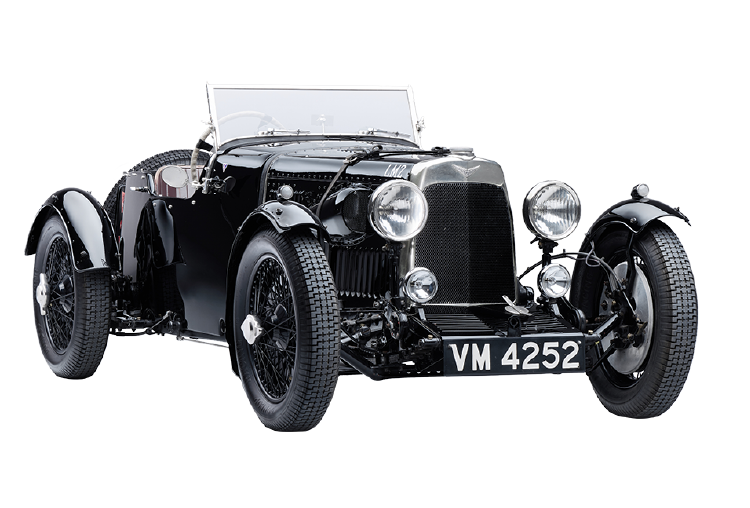
At Ecurie Bertelli, our knowledgeable team is perfectly positioned to guide you in selecting the ideal car to match your needs. With decades of experience in assisting customers to find and appreciate their classic vehicles, we are true experts in every facet of owning a pre-war Aston Martin. Let us navigate the intricacies of model eligibility and suitability with you, while providing insights into the mechanical and aesthetic condition of each vehicle.
Click to view our detailed explanation of each model of Aston-Martin.